# How would a logistics operator automate its documents?

Model case: an illustrative scenario, not an executed engagement.


> First a per-field accuracy rubric and a confidence threshold; then a rollout that moves from reviewing every document to reviewing a sample.

Date: 2026-11-17
Source: https://szemat.pro/en/cases/how-would-a-logistics-operator-automate-its-documents/

I would start by measuring accuracy field by field rather than per document, with a rubric that sets a threshold for each group of fields and a confidence threshold that decides what goes to human review. Then I would propose a gradual rollout with rollback, moving from reviewing every document to reviewing a sample. The customs fields would always stay in the hands of a person. For this scenario I estimate 4 phases over roughly 8-10 weeks.

<aside class="case-note" aria-labelledby="why-model-case">
  <p class="case-note-title" id="why-model-case">Why this is a model case</p>
  <p>This case is an illustrative scenario: it does not describe a real organization or an executed engagement, and it claims no result. The organization is generic. The ranges in the assumptions table come from cited public sources, such as official statistics or sector studies, or are delegated illustrative assumptions marked as such; none comes from the data of a real engagement. The examples in the deliverables use synthetic data.</p>
</aside>

## Context: a logistics operator between paper and electronic data

The scenario is a mid-sized logistics operator that combines road haulage, sea and air freight forwarding and customs brokerage for its customers, in one or several jurisdictions. Every month it receives thousands of delivery notes, consignment notes, bills of lading and customs declarations, and a back-office team keys their data by hand into the transport management system and the customs software. Some of them arrive scanned or photographed; the rest arrive as a digital file or as structured data. The size and volume ranges are in the assumptions table.

Not every field matters equally. An error in the package count on a delivery note gets corrected at delivery; an error in the commodity code goes into a declaration that a person signs. The same operator handles low-risk and high-risk fields, and that is why accuracy would be measured per field.

The digitization of the sector is moving forward piece by piece. According to [the European statistics on the use of AI in enterprises](https://ec.europa.eu/eurostat/statistics-explained/index.php?title=Use_of_artificial_intelligence_in_enterprises), in 2025 logistics was the least cited purpose among European enterprises that used AI, at 6.08%. Among those that did not use it, transport and storage was the second sector least likely to have considered using it, at 10.28%. At the same time, [the European regulation on electronic freight transport information](https://transport.ec.europa.eu/transport-themes/logistics-and-multimodal-transport/efti-regulation_en) aims to replace paper with electronic data in road, rail, inland waterway and air transport, and it will apply in full from 9 July 2027. In sea transport, [the container shipping industry association](https://dcsa.org/get-involved/100-percent-ebl) records the commitment of its carriers to issue 50% of their bills of lading in electronic form within 5 years and 100% by 2030. For years, the intake would mix scanned documents and structured data, and the design would have to accept both.

[The POC-to-Production Sprint](/en/sprint/) is designed for that starting point: a proof of concept that already extracts data in a demo and needs to reach production with measured accuracy, human review where it matters and a rollout that allows going back.

## Diagnosis: what the proof of concept lacks to reach production

In this scenario there is a proof of concept that extracts data well from clean documents in a demo. The problem is not the model but how it is measured: per document rather than per field, so nobody knows which fields fail. That hides the failure that costs the most in logistics: an almost correct document with the weight or the container number wrong.

On top of that, there is no confidence threshold and no rule for what goes to human review, nothing is validated against the order or against format rules, the customs fields get the same treatment as the rest, and there is no plan to move from reviewing everything to reviewing a sample. These are variants of the causes I describe when explaining [why generative AI pilots fail to reach production](/en/writing/why-genai-pilots-fail-to-reach-production/): there is no definition of ready and no evaluation that measures it, and the architecture is designed for the demo.

The diagnosis would review five dimensions, and each one leads to a deliverable. The first is accuracy per field and per document type, together with scan quality, which is the basis of [the per-field accuracy rubric](#deliverable-rubric). The second is the confidence threshold and the review queue: at what value a field goes through without a person looking at it, and how that value is calibrated, which is [the decision on the confidence threshold](#deliverable-adr). The third is validation against the order and against format rules. The fourth, the handling of the customs fields. The fifth, the move from full review to sampling: which signals allow moving forward, which ones send the flow back and who decides.

The diagnosis would end with a sample of real documents by type and scan quality, with personal data minimized, and with the available ways to load data into the target system.

## Proposal: per-field extraction, deterministic validation and human review

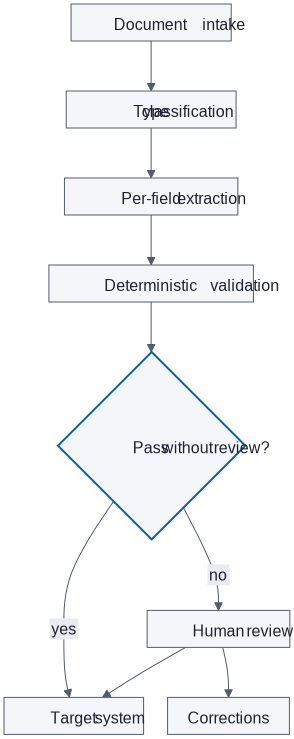
The proposal separates what the model proposes (a value and its confidence), what the code checks (rules and the match against the order) and what only a person decides (the customs declaration). The full path is in [the annotated extraction and review flow](#deliverable-diagram).

### A single intake with document classification

Every document would come in through a single path: email, customer portal or scanner. The first step would be to classify the type, because each type has its own fields, rules and thresholds. A document that does not fit any known type would go to full review. Documents that already arrive as structured data would skip extraction and go straight to validation.

### Extraction with confidence and deterministic validation

Extraction would use a multimodal model that returns each field with its value, its position in the document and a confidence score, hosted in the cloud with agreed data residency. The position makes it possible to highlight the field in the review queue.

After that, a deterministic validation would check formats, plausible dates, the check digit of the container number and the match against the order in the transport management system. This layer catches errors that the model returns with high confidence, such as transposed digits. A field would go through without review only if its confidence reaches the threshold and it passes validation.

### Human review, customs fields and corrections

The queue would show the document with the field highlighted. The customs fields (commodity code, country of origin and declared value) would always go to human review, in every phase, because a person signs the declaration. The design is meant to support that responsibility, not to replace it, and the same goes for the obligations of the case's regulatory framework, which would be validated with the legal team in each jurisdiction.

Every correction would be recorded and would feed the evaluation set. The method is the one I explain in [how to evaluate an LLM agent before deployment](/en/writing/how-to-evaluate-an-llm-agent-before-deployment/), applied to fields rather than conversations; the same approach of a gate with a published verdict can be seen in [the AI agent for regulated industries](/en/evidence/ai-agent-regulated-industries/).

### Four phases with an evaluation gate

The work would follow the stages of the Sprint in 4 phases: diagnosis and criteria; building the evaluation set, the extraction and the validation; the rollout from full review to sampling; and the handoff. The per-field evaluation harness would act as a go/no-go gate before each phase, and the rollout would advance step by step with rollback, according to [the rollout plan from full review to sampling](#deliverable-rollout). The handoff would leave the team with the harness, the rubric and the validation rules.

### Assumptions in this scenario

- The back-office team could set aside hours to label the evaluation set.
- The target system would accept an automatic load or a file import.
- The document types with the most volume would cover most of the intake.
- The duration is an estimate for the scenario, not the standard length of the Sprint.

<div class="case-table-wrap" role="region" aria-labelledby="table-baseline" tabindex="0">
  <table class="case-table">
    <caption id="table-baseline">This scenario's assumptions, as ranges</caption>
    <thead>
      <tr><th scope="col">Assumption</th><th scope="col">Range</th><th scope="col">Source</th></tr>
    </thead>
    <tbody>
      <tr><th scope="row">Operator size</th><td>between 300 and 1,500 employees</td><td>delegated illustrative assumption</td></tr>
      <tr><th scope="row">Documents received</th><td>between 20,000 and 100,000 a month</td><td>delegated illustrative assumption</td></tr>
      <tr><th scope="row">Back-office team</th><td>between 8 and 25 people</td><td>delegated illustrative assumption</td></tr>
      <tr><th scope="row">Scanned or photographed documents</th><td>between 40% and 70%</td><td>delegated illustrative assumption</td></tr>
      <tr><th scope="row">Fields to capture per document</th><td>between 10 and 30</td><td>delegated illustrative assumption</td></tr>
      <tr><th scope="row">Evaluation set</th><td>between 400 and 800 labelled documents</td><td>delegated illustrative assumption</td></tr>
      <tr><th scope="row">Length of the work</th><td>between 8 and 10 weeks</td><td>delegated illustrative assumption</td></tr>
    </tbody>
  </table>
</div>

## How success would be measured: the rubric thresholds as the gate

Success would be measured with the same targets as the rubric and the rollout plan, so that the case does not carry two versions of ready: at least 99% accuracy on identifiers, 98% on dates and quantities, 95% on parties and addresses and 98% on customs fields, the latter with 100% human review. And one condition with no margin: zero invented values in customs fields, both in the evaluation set and in review. The thresholds are a proposal for this scenario, not an industry standard, and they are stricter where an error sends goods to the wrong place or goes into a declaration.

Before each phase, the harness would compare each group with its threshold, and a group below it would block progress. In the rollout phases, the sample would measure the same accuracy on real documents.

The share of fields that go through without review and the time from receipt to the data in the target system would be measured every week against the baseline from the diagnosis, with no fixed target. They are a consequence of the threshold, not a goal that pushes it: an automation target would invite lowering the threshold.

### What could go wrong

Each risk would have a stop signal. With fewer than 400 labelled documents at the close of the diagnosis, the build would not start. Without a way to load data, the scope would shrink to filling in the review screen. A new type would not come in until it had been evaluated. If review catches less than 95% of the seeded errors, the phase would not advance. With more electronic data, the scope would be reviewed at the handoff.

<div class="case-table-wrap" role="region" aria-labelledby="table-risks" tabindex="0">
  <table class="case-table">
    <caption id="table-risks">What could go wrong, how it would be detected and mitigated</caption>
    <thead>
      <tr><th scope="col">Risk</th><th scope="col">How it would be detected</th><th scope="col">Mitigation</th></tr>
    </thead>
    <tbody>
      <tr><th scope="row">No time to label</th><td>There are few labelled documents at the close of the diagnosis</td><td>Start from documents already corrected and set aside team hours</td></tr>
      <tr><th scope="row">No automatic load</th><td>There is no interface and no file import</td><td>A file import agreed with the systems team</td></tr>
      <tr><th scope="row">More formats than expected</th><td>The sample brings formats outside the defined types</td><td>The highest-volume types first</td></tr>
      <tr><th scope="row">Review without looking</th><td>Seeded errors in control documents</td><td>Review rotates, and the team is shown which fields fail most</td></tr>
      <tr><th scope="row">More electronic data</th><td>The share of structured inputs grows</td><td>The intake accepts them and skips extraction</td></tr>
    </tbody>
  </table>
</div>

## Deliverables: four work products from this scenario

The four deliverables use synthetic data, marked as sample data, and the same thresholds and ranges as the case.

1. [Per-field accuracy rubric](#deliverable-rubric)
2. [Annotated extraction and review flow](#deliverable-diagram)
3. [Rollout plan: from full review to sampling](#deliverable-rollout)
4. [ADR: confidence threshold for human review](#deliverable-adr)

### Per-field accuracy rubric

The rubric would decide which groups of fields go through without review; the harness would apply it before each phase to labelled documents, such as the sample delivery note #ALB-2041 or the sample bill of lading #BL-0388. The gate would return no-go if a group falls below its threshold or if an invented value appears in a customs field.

<div class="case-table-wrap" role="region" aria-labelledby="deliverable-rubric" tabindex="0">
  <table class="case-table">
    <caption id="deliverable-rubric">Illustrative example: per-field accuracy rubric</caption>
    <thead><tr><th scope="col">Field</th><th scope="col">Accuracy threshold</th><th scope="col">Below the threshold</th><th scope="col">Human review</th></tr></thead>
    <tbody>
      <tr><th scope="row">Identifiers: delivery note, bill of lading and container numbers</th><td>At least 99% exact match</td><td>The whole group goes back to human review on documents of that type</td><td>According to the rollout phase</td></tr>
      <tr><th scope="row">Dates and quantities: loading date, number of packages, gross weight in kg</th><td>At least 98%</td><td>The whole group goes back to human review on documents of that type</td><td>According to the rollout phase</td></tr>
      <tr><th scope="row">Parties and addresses: shipper, consignee, delivery address</th><td>At least 95% after normalizing case, spaces and abbreviations</td><td>The whole group goes back to human review on documents of that type</td><td>According to the rollout phase</td></tr>
      <tr><th scope="row">Customs fields: commodity code, country of origin, declared value</th><td>At least 98%, with no invented value at all</td><td>No-go for the rollout of that document type</td><td>Always, in every phase</td></tr>
    </tbody>
  </table>
</div>

<figure class="deliverable">
<figcaption id="deliverable-rubric-yaml">Illustrative example: per-field rubric as an evaluation configuration</figcaption>

```yaml
rubric: per_field_accuracy
data: synthetic_sample
evaluation_set:
  documents: between_400_and_800
  labelling: by_hand_by_back_office
  split: by_document_type_and_scan_quality
groups:
  - name: identifiers
    fields: [delivery_note_number, bill_of_lading_number, container_number]
    comparison: exact_match
    min_threshold_pct: 99
  - name: dates_and_quantities
    fields: [loading_date, number_of_packages, gross_weight_kg]
    min_threshold_pct: 98
  - name: parties_and_addresses
    fields: [shipper, consignee, delivery_address]
    comparison: after_normalizing
    min_threshold_pct: 95
  - name: customs_fields
    fields: [commodity_code, country_of_origin, declared_value]
    min_threshold_pct: 98
    human_review: always
below_threshold: whole_group_to_human_review
no_go:
  - any_group_below_its_threshold
  - invented_value_in_customs_field
```

</figure>

### Annotated extraction and review flow

The diagram would show where the code decides and where a person decides; the technical team would use it to build the flow.

<figure class="deliverable-diagram">
  <img class="dg-light" src="/cases/how-would-a-logistics-operator-automate-its-documents/document-flow-en-light.svg" alt="annotated extraction and review flow" width="294" height="739" loading="lazy" decoding="async">
  <img class="dg-dark" src="/cases/how-would-a-logistics-operator-automate-its-documents/document-flow-en-dark.svg" alt="annotated extraction and review flow" width="294" height="739" loading="lazy" decoding="async">
  <figcaption>
    <p class="cd-caption-title" id="deliverable-diagram">Illustrative example: annotated extraction and review flow</p>
    <ol><li>Document intake: email, customer portal and scanner.</li><li>Classification of the document type, which sets its fields, rules and thresholds.</li><li>Per-field extraction: value, position in the document and confidence.</li><li>Deterministic validation: format, plausible dates, container check digit and match against the order. Synthetic example: the sample order #P-5531 states a sample gross weight of 1,240 kg and the extraction returns 1,420 kg with high confidence; the match against the order sends it to review.</li><li>Decision: is the confidence at or above the threshold, did validation pass and is the field not a customs field?</li><li>Yes: the data goes to the target system.</li><li>No: human review in the queue, with the field highlighted, and then the target system.</li><li>Corrections: each one is recorded and feeds the evaluation set.</li></ol>
  </figcaption>
</figure>

### Rollout plan: from full review to sampling

The plan would say how review is reduced step by step and which signal sends the flow back. Each phase would last at least two weeks, and in all three the customs fields would be reviewed on 100% of documents.

<div class="case-table-wrap" role="region" aria-labelledby="deliverable-rollout" tabindex="0">
  <table class="case-table">
    <caption id="deliverable-rollout">Illustrative example: rollout plan from full review to sampling</caption>
    <thead><tr><th scope="col">Phase</th><th scope="col">Scope and traffic</th><th scope="col">Moves forward if</th><th scope="col">Rolls back if</th></tr></thead>
    <tbody>
      <tr><th scope="row">Full review</th><td>A person reviews 100% of documents with the fields already filled in</td><td>After at least two weeks in the phase, accuracy holds the rubric thresholds in every group of fields</td><td>There is no earlier phase: if a new document type or format arrives, outside the evaluation set, the phase stops and does not move forward until it has been evaluated. Decides: product owner</td></tr>
      <tr><th scope="row">Confidence-based review</th><td>Only fields below the threshold or that failed validation, plus a random sample of 20% of accepted documents</td><td>After at least two weeks in the phase, the sample holds the rubric thresholds in every group of fields</td><td>An error in an identifier found after the data was loaded, for example a delivery sent to the wrong destination, returns the flow to full review at once. Decides: operations manager</td></tr>
      <tr><th scope="row">Sampling</th><td>A random sample of 5% of accepted documents</td><td>The sample keeps holding the rubric thresholds in every group of fields</td><td>A group of fields below its threshold in the sample returns the flow to confidence-based review. Decides: document administration lead. An error in an identifier that was already loaded returns the flow to full review at once. Decides: operations manager</td></tr>
    </tbody>
  </table>
</div>

### ADR: confidence threshold for human review

The decision record would set how the confidence threshold of each group of fields is chosen and recalculated.

<figure class="deliverable">
<figcaption id="deliverable-adr">Illustrative example: confidence threshold for human review</figcaption>

```markdown
---
status: Proposed (illustrative scenario)
date: the date of the case
deciders: document administration lead and technical lead
---
# Sample ADR: confidence threshold for human review

## Context and Problem Statement
Extraction returns a confidence score per field, but that confidence is not
calibrated: a value can be wrong with high confidence.

## Decision Drivers
- The costliest errors: identifiers and customs fields.
- The rubric's accuracy thresholds, per group of fields.
- The review workload of the back-office team.

## Considered Options
1. A threshold per group of fields calibrated on the evaluation set,
   combined with deterministic validation.
2. A single threshold per document.
3. Human review of everything, with no threshold.

## Decision Outcome
Recommended option: the first, a threshold per group with deterministic validation.

### Consequences
- A field goes through without review only if it reaches its threshold and passes validation.
- Customs fields are outside the threshold and are always reviewed.
- The threshold is recalculated when the model changes or a new document type comes in.

### Confirmation
For each group, the chosen threshold is the lowest one at which the accuracy of
the fields accepted without review reaches the rubric threshold on the
evaluation set. Synthetic example: a sample confidence threshold of 0.90 for
dates and quantities; a field with a sample confidence of 0.72 goes to the queue.

## Pros and Cons of the Options
- Per group: requires calibrating each group; separates fields of different risk.
- Single per document: simple; a weak field hides in the average.
- Review of everything: accepts nothing unchecked; does not reduce the review load.
```

</figure>

## Applicable regulatory framework

> General information, not legal advice. It is advisable to validate it with each organization's compliance team.

[See the full regulatory matrix](https://szemat.pro/en/regulatory-matrix/)

Instruments that could apply to this case, to validate with the compliance team

- [Bill 16.821-19 (Regula los sistemas de inteligencia artificial)](https://szemat.pro/en/regulatory-matrix/#cl-boletin-16821-19) · Jurisdiction: Chile · Industry: Cross-sector · Applicability: Preparation · Condition: Expected to apply: no official date. Not applicable on the access date: it is advisable to include it among the norms to validate with the compliance team. · Status: Bill
- [Decree 295 of 2024 (Aprueba reglamento de reporte de incidentes de ciberseguridad de la ley N° 21.663)](https://szemat.pro/en/regulatory-matrix/#cl-decreto-295-2024) · Jurisdiction: Chile · Industry: Cross-sector · Applicability: Conditional · Condition: If this instrument includes the logistics operator among the entities or operators it binds, a security incident in an AI system would fall under its management and reporting duties. · Status: In force
- [DFL 30 of 2004 (Aprueba el texto refundido, coordinado y sistematizado del decreto con fuerza de ley de Hacienda N° 213, de 1953, sobre Ordenanza de Aduanas)](https://szemat.pro/en/regulatory-matrix/#cl-dfl-30-2004) · Jurisdiction: Chile · Industry: Cross-sector, Logistics and transport · Applicability: Direct · Status: In force
- [Law 19.628 (Sobre protección de la vida privada)](https://szemat.pro/en/regulatory-matrix/#cl-ley-19628) · Jurisdiction: Chile · Industry: Cross-sector · Applicability: Direct · Condition: Pending part: Law 21.719 (Regula la protección y el tratamiento de los datos personales y crea la Agencia de Protección de Datos Personales) (2026-12-01) · Status: In force
- [Law 21.663 (Ley Marco de Ciberseguridad)](https://szemat.pro/en/regulatory-matrix/#cl-ley-21663) · Jurisdiction: Chile · Industry: Cross-sector · Applicability: Conditional · Condition: If this instrument includes the logistics operator among the entities or operators it binds, a security incident in an AI system would fall under its management and reporting duties. · Status: In force
- [Law 21.719 (Regula la protección y el tratamiento de los datos personales y crea la Agencia de Protección de Datos Personales)](https://szemat.pro/en/regulatory-matrix/#cl-ley-21719) · Jurisdiction: Chile · Industry: Cross-sector · Applicability: Preparation · Condition: Expected to apply 2026-12-01. Not applicable on the access date: it is advisable to include it among the norms to validate with the compliance team. · Status: Adopted, not yet applicable
- [Bill 025 of 2026 (Chamber of Representatives) (Por medio de la cual se regula la inteligencia artificial en Colombia para garantizar su desarrollo ético y responsable y se dictan otras disposiciones)](https://szemat.pro/en/regulatory-matrix/#co-pl-025-2026) · Jurisdiction: Colombia · Industry: Cross-sector · Applicability: Preparation · Condition: Expected to apply: no official date. Not applicable on the access date: it is advisable to include it among the norms to validate with the compliance team. · Status: Bill
- [Decree 1165 of 2019 (Por el cual se dictan disposiciones relativas al Régimen de Aduanas en desarrollo de la Ley 1609 de 2013)](https://szemat.pro/en/regulatory-matrix/#co-decreto-1165) · Jurisdiction: Colombia · Industry: Logistics and transport · Applicability: Direct · Status: In force
- [Decree 1377 of 2013 (Por el cual se reglamenta parcialmente la Ley 1581 de 2012)](https://szemat.pro/en/regulatory-matrix/#co-decreto-1377) · Jurisdiction: Colombia · Industry: Cross-sector · Applicability: Direct · Status: In force
- [SIC External Circular 002 of 2024 (Lineamientos sobre el Tratamiento de Datos personales en Sistemas de Inteligencia Artificial)](https://szemat.pro/en/regulatory-matrix/#co-sic-ce-002-2024) · Jurisdiction: Colombia · Industry: Cross-sector · Applicability: Direct · Status: In force
- [Statutory Law 1581 of 2012 (Por la cual se dictan disposiciones generales para la protección de datos personales)](https://szemat.pro/en/regulatory-matrix/#co-ley-1581) · Jurisdiction: Colombia · Industry: Cross-sector · Applicability: Direct · Status: In force
- [Law 29733 (Ley de Protección de Datos Personales)](https://szemat.pro/en/regulatory-matrix/#pe-ley-29733) · Jurisdiction: Peru · Industry: Cross-sector · Applicability: Direct · Status: In force
- [Law 31814 (Ley que promueve el uso de la inteligencia artificial en favor del desarrollo económico y social del país)](https://szemat.pro/en/regulatory-matrix/#pe-ley-31814) · Jurisdiction: Peru · Industry: Cross-sector · Applicability: Direct · Status: In force
- [Legislative Decree 1053 (Decreto Legislativo que aprueba la Ley General de Aduanas)](https://szemat.pro/en/regulatory-matrix/#pe-dl-1053) · Jurisdiction: Peru · Industry: Logistics and transport · Applicability: Direct · Status: In force
- [Superintendency Resolution 000123-2022/SUNAT (Modifican la normativa sobre guías de remisión y designan emisores electrónicos)](https://szemat.pro/en/regulatory-matrix/#pe-rs-000123-2022-sunat) · Jurisdiction: Peru · Industry: Logistics and transport · Applicability: Conditional · Condition: If the operator is designated as an electronic issuer of waybills (guías de remisión), the extracted data that feeds those waybills would fall under these rules on the documents that support the movement of goods. · Status: In force
- [Supreme Decree 016-2024-JUS (Reglamento de la Ley Nº 29733, Ley de Protección de Datos Personales)](https://szemat.pro/en/regulatory-matrix/#pe-ds-016-2024-jus) · Jurisdiction: Peru · Industry: Cross-sector · Applicability: Direct · Condition: Pending part: Data protection officer mandatory for medium companies (annual sales above 1700 and up to 2300 UIT) (2026-11-30); Data protection officer mandatory for small companies (annual sales above 150 and up to 1700 UIT) (2027-11-30); Data protection officer mandatory for microenterprises (annual sales up to 150 UIT) (2028-11-30) · Status: Partially in force
- [Supreme Decree 115-2025-PCM (Reglamento de la Ley Nº 31814, Ley que promueve el uso de la inteligencia artificial en favor del desarrollo económico y social del país)](https://szemat.pro/en/regulatory-matrix/#pe-ds-115-2025-pcm) · Jurisdiction: Peru · Industry: Cross-sector · Applicability: Conditional · Condition: If the document extraction is considered an AI use in transport or commerce, the provisions for the private sector would apply to it in the stage for those uses, which starts on 2027-09-10. Pending part: Private sector: AI uses in transport, commerce and labour, and small companies (2027-09-10); Private sector: AI uses in production, agriculture, energy and mining, and microenterprises (2028-09-10); Private sector: all other AI uses (2029-09-10) · Status: Partially in force
- [Supreme Decree 126-2025-PCM (Decreto Supremo que aprueba el Reglamento del Decreto de Urgencia N° 007-2020, Decreto de Urgencia que aprueba el Marco de Confianza Digital y dispone medidas para su fortalecimiento)](https://szemat.pro/en/regulatory-matrix/#pe-ds-126-2025-pcm) · Jurisdiction: Peru · Industry: Cross-sector · Applicability: Conditional · Condition: If the extraction system suffers a critical digital security incident, its notification to the National Digital Security Center would come into play. · Status: In force
- [Decree 1558/2001 (Apruébase la reglamentación de la Ley Nº 25.326)](https://szemat.pro/en/regulatory-matrix/#ar-decreto-1558-2001) · Jurisdiction: Argentina · Industry: Cross-sector · Applicability: Direct · Status: In force
- [Law 22.415 (Código Aduanero)](https://szemat.pro/en/regulatory-matrix/#ar-ley-22415) · Jurisdiction: Argentina · Industry: Cross-sector, Logistics and transport · Applicability: Direct · Status: In force
- [Law 25.326 (Ley de Protección de los Datos Personales)](https://szemat.pro/en/regulatory-matrix/#ar-ley-25326) · Jurisdiction: Argentina · Industry: Cross-sector · Applicability: Direct · Status: In force
- [Law 26.994 (Código Civil y Comercial de la Nación)](https://szemat.pro/en/regulatory-matrix/#ar-ley-26994) · Jurisdiction: Argentina · Industry: Cross-sector, Logistics and transport · Applicability: Conditional · Condition: If the operator enters into or performs transport contracts in Argentina, the consignment note (carta de porte) and the cargo receipt (guía) this code regulates would be input documents of the flow, and their data would go through the same validation. · Status: In force
- [Código de Comercio](https://szemat.pro/en/regulatory-matrix/#ec-codigo-comercio) · Jurisdiction: Ecuador · Industry: Cross-sector, Retail and e-commerce, Logistics and transport · Applicability: Conditional · Condition: If the operator enters into transport contracts in Ecuador, the waybill (guía de remisión) or consignment note (carta de porte) and the bill of lading this code regulates would be input documents of the flow. · Status: In force
- [Código Orgánico de la Producción, Comercio e Inversiones](https://szemat.pro/en/regulatory-matrix/#ec-copci) · Jurisdiction: Ecuador · Industry: Logistics and transport · Applicability: Direct · Status: In force
- [Executive Decree 904 (Reglamento General de la Ley Orgánica de Protección de Datos Personales)](https://szemat.pro/en/regulatory-matrix/#ec-rglopdp) · Jurisdiction: Ecuador · Industry: Cross-sector · Applicability: Direct · Status: In force
- [Ley Orgánica de Protección de Datos Personales](https://szemat.pro/en/regulatory-matrix/#ec-lopdp) · Jurisdiction: Ecuador · Industry: Cross-sector · Applicability: Direct · Condition: Pending part: Filing 483742 (Proyecto de Ley Orgánica Reformatoria a la Ley Orgánica de Protección de Datos Personales) (no official date) · Status: In force
- [Ley Orgánica para el Fortalecimiento de la Ciberseguridad](https://szemat.pro/en/regulatory-matrix/#ec-ley-ciberseguridad) · Jurisdiction: Ecuador · Industry: Cross-sector · Applicability: Conditional · Condition: If the operator is a critical digital infrastructure operator under this law, an incident in the extraction system would fall under its notice to the governing body. · Status: In force
- [Proyecto de Ley Orgánica para el Desarrollo, Uso Ético y Gobernanza de la Inteligencia Artificial en el Ecuador](https://szemat.pro/en/regulatory-matrix/#ec-proyecto-ley-ia) · Jurisdiction: Ecuador · Industry: Cross-sector · Applicability: Preparation · Condition: Expected to apply: no official date. Not applicable on the access date: it is advisable to include it among the norms to validate with the compliance team. · Status: Bill
- [Resolution SPDP-SPD-2026-0009-R (Norma General para la Garantía del Derecho de Protección de Datos Personales en el Uso de Sistemas de Inteligencia Artificial)](https://szemat.pro/en/regulatory-matrix/#ec-spdp-2026-0009-r) · Jurisdiction: Ecuador · Industry: Cross-sector · Applicability: Direct · Status: In force
- [Resolution SPDP-SPD-2026-0040-R (Norma Técnica de Notificaciones de Vulneraciones de la Seguridad de los Datos Personales)](https://szemat.pro/en/regulatory-matrix/#ec-spdp-2026-0040-r) · Jurisdiction: Ecuador · Industry: Cross-sector · Applicability: Conditional · Condition: If an incident in an AI system affects personal data (for example, a leak through prompt injection), the breach would have to be notified on the terms of this instrument. · Status: In force
- [Ley Aduanera](https://szemat.pro/en/regulatory-matrix/#mx-ley-aduanera) · Jurisdiction: Mexico · Industry: Cross-sector, Logistics and transport · Applicability: Direct · Status: In force
- [Ley Federal de Protección de Datos Personales en Posesión de los Particulares](https://szemat.pro/en/regulatory-matrix/#mx-lfpdppp) · Jurisdiction: Mexico · Industry: Cross-sector · Applicability: Direct · Status: In force
- [Resolución Miscelánea Fiscal para 2026](https://szemat.pro/en/regulatory-matrix/#mx-rmf-2026) · Jurisdiction: Mexico · Industry: Logistics and transport · Applicability: Conditional · Condition: If the operator carries goods in Mexico, the data extracted from consignment notes would feed the CFDI (electronic tax receipt) with the Carta Porte supplement this resolution calls for, so an error in a quantity or an identifier would reach that tax receipt. · Status: In force
- [Executive Decree 37554-JP (Reglamento a la Ley de Protección de la Persona frente al Tratamiento de sus Datos Personales)](https://szemat.pro/en/regulatory-matrix/#cr-de-37554-jp) · Jurisdiction: Costa Rica · Industry: Cross-sector · Applicability: Direct · Status: In force
- [Law 7557 (Ley General de Aduanas)](https://szemat.pro/en/regulatory-matrix/#cr-ley-7557) · Jurisdiction: Costa Rica · Industry: Cross-sector, Logistics and transport · Applicability: Direct · Status: In force
- [Law 8968 (Ley de Protección de la Persona frente al tratamiento de sus datos personales)](https://szemat.pro/en/regulatory-matrix/#cr-ley-8968) · Jurisdiction: Costa Rica · Industry: Cross-sector · Applicability: Direct · Status: In force
- [ANPD Resolution CD/ANPD No. 19/2024 (Aprova o Regulamento de Transferência Internacional de Dados e o conteúdo das cláusulas-padrão contratuais)](https://szemat.pro/en/regulatory-matrix/#br-anpd-res-19-2024) · Jurisdiction: Brazil · Industry: Cross-sector · Applicability: Conditional · Condition: If the model or cloud the AI system uses is outside the country, the international transfer of personal data would follow these rules; the case does not say where the models run. · Status: In force
- [Bill PL 2338/2023 (Dispõe sobre o desenvolvimento, o fomento e o uso ético e responsável da inteligência artificial com base na centralidade da pessoa humana)](https://szemat.pro/en/regulatory-matrix/#br-pl-2338-2023) · Jurisdiction: Brazil · Industry: Cross-sector · Applicability: Preparation · Condition: Expected to apply: no official date. Not applicable on the access date: it is advisable to include it among the norms to validate with the compliance team. · Status: Bill
- [Decree 6.759/2009 (Regulamento Aduaneiro)](https://szemat.pro/en/regulatory-matrix/#br-decreto-6759-2009) · Jurisdiction: Brazil · Industry: Cross-sector, Logistics and transport · Applicability: Direct · Status: In force
- [Law 10.406/2002 (Código Civil)](https://szemat.pro/en/regulatory-matrix/#br-lei-10406) · Jurisdiction: Brazil · Industry: Cross-sector, Logistics and transport · Applicability: Conditional · Condition: If the operator acts as a carrier in Brazil, the bill of carriage (conhecimento) it issues on receiving the goods under this code would be an input document of the flow. · Status: In force
- [Law 11.442/2007 (Dispõe sobre o transporte rodoviário de cargas por conta de terceiros e mediante remuneração e revoga a Lei nº 6.813, de 10 de julho de 1980)](https://szemat.pro/en/regulatory-matrix/#br-lei-11442) · Jurisdiction: Brazil · Industry: Logistics and transport · Applicability: Conditional · Condition: If the operator carries road freight for third parties in Brazil, the transport contract or bill of carriage (conhecimento de transporte) this law calls for would be an input document of the flow. · Status: In force
- [Law 13.709/2018 (Lei Geral de Proteção de Dados Pessoais (LGPD))](https://szemat.pro/en/regulatory-matrix/#br-lei-13709) · Jurisdiction: Brazil · Industry: Cross-sector · Applicability: Direct · Status: In force
- [Decree 414/009 (Reglamentación de la Ley 18.331, relativo a la protección de datos personales)](https://szemat.pro/en/regulatory-matrix/#uy-decreto-414-009) · Jurisdiction: Uruguay · Industry: Cross-sector · Applicability: Direct · Status: In force
- [Decree 64/020 (Reglamentación de los arts. 37 a 40 de la Ley 19.670 y art. 12 de la Ley 18.331, referente a protección de datos personales)](https://szemat.pro/en/regulatory-matrix/#uy-decreto-64-020) · Jurisdiction: Uruguay · Industry: Cross-sector · Applicability: Conditional · Condition: If an incident in an AI system affects personal data (for example, a leak through prompt injection), the breach would have to be notified on the terms of this instrument. · Status: In force
- [Law 18.331 (Ley de Protección de Datos Personales)](https://szemat.pro/en/regulatory-matrix/#uy-ley-18331) · Jurisdiction: Uruguay · Industry: Cross-sector · Applicability: Direct · Status: In force
- [Law 19.276 (Customs Code) (Aprobación del Código Aduanero)](https://szemat.pro/en/regulatory-matrix/#uy-ley-19276) · Jurisdiction: Uruguay · Industry: Logistics and transport · Applicability: Direct · Status: In force
- [Law 19.670 (arts. 37 to 40) (Aprobación de Rendición de Cuentas y Balance de Ejecución Presupuestal. Ejercicio 2017)](https://szemat.pro/en/regulatory-matrix/#uy-ley-19670-arts-37-40) · Jurisdiction: Uruguay · Industry: Cross-sector · Applicability: Conditional · Condition: If an incident in an AI system affects personal data (for example, a leak through prompt injection), the breach would have to be notified on the terms of this instrument. · Status: In force
- [Law 20.212 (arts. 78 to 84) (Aprobación de Rendición de Cuentas y Balance de Ejecución Presupuestal. Ejercicio 2022)](https://szemat.pro/en/regulatory-matrix/#uy-ley-20212-arts-78-84) · Jurisdiction: Uruguay · Industry: Cross-sector · Applicability: Conditional · Condition: If the operator is a private entity in a critical service or sector under this law, an incident in the extraction system would fall under its report to AGESIC. · Status: In force
- [19 CFR Part 149 (Importer Security Filing)](https://szemat.pro/en/regulatory-matrix/#us-19-cfr-149) · Jurisdiction: United States (federal and key states) · Industry: Logistics and transport · Applicability: Conditional · Condition: If the operator prepares this filing on behalf of importers for ocean cargo bound for the US, the data would have to be transmitted before the cargo is laden on the vessel at the foreign port, within the deadline this rule sets, so the review of the customs fields would have to finish before then. · Status: In force
- [49 U.S.C. 80101 et seq. (Bills of Lading)](https://szemat.pro/en/regulatory-matrix/#us-49-usc-80101) · Jurisdiction: United States (federal and key states) · Industry: Logistics and transport · Applicability: Conditional · Condition: If the operator issues or receives bills of lading in carriage governed by this chapter, those documents would be inputs to the flow, and the bill of lading number would sit in the identifiers group of the rubric. · Status: In force
- [Cal. Civ. Code 1798.100 et seq. (California Consumer Privacy Act of 2018)](https://szemat.pro/en/regulatory-matrix/#us-ca-ccpa) · Jurisdiction: United States (federal and key states) · Industry: Cross-sector · Applicability: Conditional · Condition: If the operator is a business in scope of the act and the documents include personal data of California residents, such as drivers or consignees, its rights and duties would come into play. Pending part: Section 1798.136 (browsers with an opt-out preference signal) becomes operative (2027-01-01) · Status: Partially in force
- [H.R. 5388 (119th Congress) (American Artificial Intelligence Leadership and Uniformity Act)](https://szemat.pro/en/regulatory-matrix/#us-hr-5388) · Jurisdiction: United States (federal and key states) · Industry: Cross-sector · Applicability: Preparation · Condition: Expected to apply: no official date. Not applicable on the access date: it is advisable to include it among the norms to validate with the compliance team. · Status: Bill
- [Directive (EU) 2022/2555 (NIS 2 Directive)](https://szemat.pro/en/regulatory-matrix/#eu-directiva-2022-2555) · Jurisdiction: European Union · Industry: Cross-sector · Applicability: Conditional · Condition: If this instrument includes the logistics operator among the entities or operators it binds, a security incident in an AI system would fall under its management and reporting duties. Pending part: COM(2026) 13 (as regards simplification measures and alignment with the proposal for the Cybersecurity Act 2) (no official date); COM(2025) 837 (Digital Omnibus) (no official date) · Status: In force
- [Regulation (EU) 2016/679 (General Data Protection Regulation)](https://szemat.pro/en/regulatory-matrix/#eu-reglamento-2016-679) · Jurisdiction: European Union · Industry: Cross-sector · Applicability: Direct · Condition: Pending part: COM(2025) 837 (Digital Omnibus) (no official date); COM(2025) 501 (extension of certain mitigating measures available for small and medium sized enterprises to small mid-cap enterprises and further simplification measures) (no official date) · Status: In force
- [Regulation (EU) 2020/1056 (on electronic freight transport information)](https://szemat.pro/en/regulatory-matrix/#eu-reglamento-2020-1056) · Jurisdiction: European Union · Industry: Logistics and transport · Applicability: Conditional · Condition: If the operator makes regulatory information on the carriage of goods available electronically, this regulation would come into play, and the flow would receive more structured data that would skip extraction. Pending part: Competent authorities must accept regulatory information made available electronically (Article 5(1); computed date) (2027-07-09) · Status: Partially in force
- [Regulation (EU) 2024/1689 (Artificial Intelligence Act)](https://szemat.pro/en/regulatory-matrix/#eu-reglamento-2024-1689) · Jurisdiction: European Union · Industry: Cross-sector · Applicability: Conditional · Condition: If the extraction system is deployed in the EU, the operator would have the deployer duties (for example, taking measures to support the AI literacy of its staff); extracting data from transport and customs documents is not listed as such in Annex III, and the classification of the specific use would be validated with the legal team. Pending part: The Article 5 prohibitions dated by Regulation (EU) 2026/1744 apply, and the Article 50(2) deadline falls due for generative systems placed on the market before 2026-08-02 (2026-12-02); Article 111(3) deadline for general-purpose AI models placed on the market before 2025-08-02 (2027-08-02); Chapter III, Sections 1 to 3, for high-risk systems under Article 6(2) and Annex III (2027-12-02); Chapter III, Sections 1 to 3, for high-risk systems under Article 6(1) and Annex I (2028-08-02); COM(2025) 1023 (simplifying and reducing the burden of the rules on medical devices and in vitro diagnostic medical devices) (no official date) · Status: Partially in force
- [Regulation (EU) 2026/2108 (establishing the Union Customs Code and the European Union Customs Authority)](https://szemat.pro/en/regulatory-matrix/#eu-reglamento-2026-2108) · Jurisdiction: European Union · Industry: Logistics and transport · Applicability: Conditional · Condition: If the operator is still preparing customs declarations in the EU when the general application of this code begins, those declarations would be governed by it, and the validation rules for the customs fields would need to be reviewed with the legal team. Pending part: General application (Article 287(2)) and repeal of Regulation (EU) No 952/2013 (2027-09-21); Article 287(5) provisions on the EU Customs Data Hub, distance sales included (2028-07-01); Optional use of the EU Customs Data Hub by other importers, exporters and holders of the transit procedure (Article 285(4)) (2031-03-01); Mandatory use of the EU Customs Data Hub to place goods under a customs procedure (Article 285(5)) (2034-03-01) · Status: Partially in force
- [Regulation (EU) No 952/2013 (laying down the Union Customs Code)](https://szemat.pro/en/regulatory-matrix/#eu-reglamento-2013-952) · Jurisdiction: European Union · Industry: Logistics and transport · Applicability: Direct · Condition: Pending part: Repeal by Regulation (EU) 2026/2108 (computed date) (2027-09-21) · Status: In force
- [Law 15/2009 (Del contrato de transporte terrestre de mercancías)](https://szemat.pro/en/regulatory-matrix/#es-ley-15-2009) · Jurisdiction: Spain · Industry: Logistics and transport · Applicability: Conditional · Condition: If the operator contracts or performs land carriage of goods in Spain, the consignment note this law regulates would be an input document of the flow. · Status: In force
- [Organic Law 12/1995 (De Represión del Contrabando)](https://szemat.pro/en/regulatory-matrix/#es-lo-12-1995) · Jurisdiction: Spain · Industry: Logistics and transport · Applicability: Conditional · Condition: If a customs declaration prepared with this data were found to involve a smuggling offence, the national penalty regime of this law would come into play. · Status: In force
- [Organic Law 3/2018 (Protección de Datos Personales y garantía de los derechos digitales)](https://szemat.pro/en/regulatory-matrix/#es-lo-3-2018) · Jurisdiction: Spain · Industry: Cross-sector · Applicability: Direct · Status: In force
- [Royal Decree-law 12/2018 (De seguridad de las redes y sistemas de información)](https://szemat.pro/en/regulatory-matrix/#es-rdl-12-2018) · Jurisdiction: Spain · Industry: Cross-sector · Applicability: Conditional · Condition: If this instrument includes the logistics operator among the entities or operators it binds, a security incident in an AI system would fall under its management and reporting duties. · Status: In force
- [Cyber Security and Resilience (Network and Information Systems) Bill](https://szemat.pro/en/regulatory-matrix/#uk-csr-bill) · Jurisdiction: United Kingdom · Industry: Cross-sector · Applicability: Preparation · Condition: Expected to apply: no official date. Not applicable on the access date: it is advisable to include it among the norms to validate with the compliance team. · Status: Bill
- [Data Protection Act 2018](https://szemat.pro/en/regulatory-matrix/#uk-dpa-2018) · Jurisdiction: United Kingdom · Industry: Cross-sector · Applicability: Direct · Status: In force
- [Electronic Trade Documents Act 2023](https://szemat.pro/en/regulatory-matrix/#uk-etda-2023) · Jurisdiction: United Kingdom · Industry: Cross-sector, Logistics and transport · Applicability: Conditional · Condition: If the operator receives bills of lading or other electronic trade documents that meet the criteria of this act, they would have the same effect as paper, and the flow would treat them as structured data. · Status: In force
- [Regulation (EU) 2016/679 (United Kingdom General Data Protection Regulation)](https://szemat.pro/en/regulatory-matrix/#uk-gdpr) · Jurisdiction: United Kingdom · Industry: Cross-sector · Applicability: Direct · Status: In force
- [S.I. 2018/506 (The Network and Information Systems Regulations 2018)](https://szemat.pro/en/regulatory-matrix/#uk-nis-2018) · Jurisdiction: United Kingdom · Industry: Cross-sector · Applicability: Conditional · Condition: If this instrument includes the logistics operator among the entities or operators it binds, a security incident in an AI system would fall under its management and reporting duties. Pending part: S.I. 2026/230 (The Aviation Security (Amendment, Revocation and Consequential Provision) Regulations 2026) (2027-01-25); Cyber Security and Resilience (Network and Information Systems) Bill (no official date) · Status: In force
- [Taxation (Cross-border Trade) Act 2018](https://szemat.pro/en/regulatory-matrix/#uk-tcta-2018) · Jurisdiction: United Kingdom · Industry: Cross-sector, Logistics and transport · Applicability: Direct · Condition: Pending part: S.I. 2026/984 (The Customs (Tariff and Miscellaneous Amendments) (No. 6) Regulations 2026) (2026-12-14); Finance Act 2026, sections 110 and 111 (no official date) · Status: In force

## Claims register

- claim-1, Illustrative assumption: The figures of this scenario (size, documents, team, fields, evaluation set and length) are delegated illustrative assumptions given as ranges, not data from an executed engagement. (Basis: [Assumptions in this scenario](https://szemat.pro/en/cases/how-would-a-logistics-operator-automate-its-documents/#assumptions-in-this-scenario); As of 2026-11-17)
- claim-2, Regulatory: If the extraction system is deployed in the EU, the operator would have the deployer duties under Regulation (EU) 2024/1689, and extracting data from transport and customs documents is not listed as such in its Annex III. (Basis: [Regulation (EU) 2024/1689 (Artificial Intelligence Act)](https://szemat.pro/en/regulatory-matrix/#eu-reglamento-2024-1689); As of 2026-11-13)

## Frequently asked questions

### Why measure accuracy per field rather than per document?

Because an almost correct document can get exactly the costliest data point wrong, such as the container number or a field of the declaration. A per-document measure hides that failure; a per-field measure shows which group of fields can go through without review and which cannot.

### What happens to a field the model returns with high confidence but gets wrong?

The model's confidence is not enough. After extraction, a deterministic validation would check formats, plausible dates, the container check digit and the match against the order, and any field that failed it would go to review even with high confidence.

### Why are the customs fields always reviewed?

Because a person signs the customs declaration. The model would propose the commodity code, the country of origin and the declared value, but a person would review them on every document and in every phase of the rollout.

### Who decides to go back to reviewing everything, and when?

Each signal has a named owner in the rollout plan: operations for an error in an identifier that has already been loaded, document administration for a group of fields below its threshold, and the product owner for a new document type.

### What happens when a new document format arrives?

It goes back to full review until it is added to the evaluation set and measured. The proposal would not extend automation to a document type that the harness has not evaluated.

### What changes when documents arrive in electronic form?

The intake would accept structured data and skip extraction for it, with the same validation and the same record. If that share grows, the scope would be reviewed at the handoff.
