# How would a public body govern its use of AI?

Model case: an illustrative scenario, not an executed engagement.


> I would inventory and classify every use, set a rubric before buying and leave a two-tier public register with human oversight.

Date: 2026-11-17
Source: https://szemat.pro/en/cases/how-would-a-public-body-govern-its-use-of-ai/

First I would inventory every AI use in the body, including the AI that arrives inside licenses, and classify each one by its risk. Then I would set a purchasing rubric, a two-tier public algorithm register and human oversight with an owner for each use. As a fractional head of AI, I would leave that cycle in the hands of the body's own staff, tested first on its highest-risk use.

<aside class="case-note" aria-labelledby="why-model-case">
  <p class="case-note-title" id="why-model-case">Why this is a model case</p>
  <p>This case is an illustrative scenario: it does not describe a real organization or an executed engagement, and it claims no result. The organization is generic. The ranges in the assumptions table come from cited public sources, such as official statistics or sector studies, or are delegated illustrative assumptions marked as such; none comes from the data of a real engagement. The examples in the deliverables use synthetic data.</p>
</aside>

## Context: a body that already uses AI with no overall view

The scenario is a generic mid-sized public body that serves the public directly: information and procedures, grants and benefits, licenses and permits, in person, by phone and on the web. Whether it is national, regional or local depends on the jurisdiction, so that the case holds in all thirteen jurisdictions of the matrix. The size and the volumes are in the assumptions table, as ranges.

The body already uses AI with no overall view. The citizen services team has an information assistant on the website that came with the portal contract. A benefits unit tried out a tool that sorts applications so they can be reviewed sooner. Several units transcribe and summarize calls, the office and document management licenses ship with AI features switched on by default, and there are generative AI pilots in two or three units.

The relationship with public administration is already mostly digital. According to [the Eurostat statistics on e-government](https://ec.europa.eu/eurostat/statistics-explained/index.php?title=E-government_and_electronic_identification), in 2025, 72% of people aged 16 to 74 across the EU had used a website or an app of a public authority in the previous 12 months, and the most cited use was getting information about services, benefits, laws or opening hours (44%).

Public purchasing matters as well. According to [the European Commission page on public procurement](https://single-market-economy.ec.europa.eu/single-market/public-procurement_en), more than 250,000 EU public authorities spend around 15% of EU GDP each year on services, works and supplies, and 55% of procedures use the lowest price as the only award criterion. Nobody asks the AI that comes in this way for transparency or for an exit route.

This is where [the Fractional Head of AI service](/en/fractional/) fits: senior leadership that leaves behind a governance system the body's own staff can run.

## Diagnosis: five dimensions with no owner and no criterion

The diagnosis would review five dimensions, and none of them is about technology:

- Inventory of uses and their classification: it does not exist.
- Purchasing and tender criteria: tender documents with no AI clauses, awarded mostly on price.
- Public algorithm register: it does not exist.
- Human oversight and an owner for each use: there is neither a criterion nor an owner.
- Review and withdrawal of each use: no date and no procedure.

If an access to information request arrives, or the governing board asks which algorithms the body uses, nobody can give a complete answer.

The inventory would come first, and not only by asking the units. The AI that most often slips through arrives inside licenses and contracts: nobody bought it as AI, so nobody declares it. That is why I would go through every current contract and license.

Purchasing would come next. With no AI clauses in the tender documents, the body cannot ask for the documentation that the assessment and the register depend on; [the purchasing rubric for AI systems](#deliverable-rubric) would close that gap. Any bias, opacity or vendor dependence would go into [the risk register for the public use of AI](#deliverable-risks), which would point, where relevant, to [the risks OWASP describes for applications built on language models](https://github.com/GenAI-Security-Project/GenAI-LLM-Top10/tree/main/2026/final).

## Proposal: a governance cycle the body runs itself

The body decides what is used and on what terms, and human oversight and publication come before the use, not after it.

### Four stages and a committee with a mandate

I estimate 4 stages for this scenario, over about 12-16 weeks: inventory and classification; purchasing criteria and the rubric; the register and human oversight; and a first full cycle on a real use. They would fit within a horizon of 6 to 12 months, reviewed every quarter. That figure is this case's estimate, not the usual duration of the service.

The governing board would set up, through a formal act or instruction, an AI governance committee of 5 to 7 people: IT, data protection, legal services, procurement, information security and one unit that delivers services.

The first full cycle would run on the tool that sorts benefit applications, which is the use carrying the most risk.

### Five rules before using any AI

The committee would apply five rules:

- no AI use, whether bought, built in-house or included in a license, without an inventory entry and a classification;
- no purchase or renewal involving AI unless it passes the rubric;
- every use with an owning unit and a review date;
- in high-risk uses, no decision affecting a person goes out unless another person reviews and signs it, and the person affected can ask for a review;
- the register is published before the use begins and updated at every review.

The rules follow [the AI governance cycle](#deliverable-diagram), and the content of the register would be settled in [the ADR on the algorithm register](#deliverable-adr). An in-house generative AI tool would use a cloud-hosted model with agreed data residency, a log of every use and an exit clause. Oversight would follow [the guardrails for AI in regulated industries](/en/writing/ai-guardrails-for-regulated-industries/), as in [the AI agent for regulated industries](/en/evidence/ai-agent-regulated-industries/).

### How each use in the inventory would be classified

Each use would be classed as high-risk, transparency or minimal risk, noting whether it produces administrative acts with no direct human intervention, a point the legal team in each jurisdiction would validate. The applicable framework table holds the rows on public procurement, algorithmic transparency, personal data, cybersecurity and [the EU Artificial Intelligence Act](https://eur-lex.europa.eu/eli/reg/2024/1689/oj). Applied to the sample uses:

- The website information assistant (#IA-01) would be a transparency use: Article 50(1) requires the provider to ensure that people are informed they are interacting with an AI system, and the body would ask for this when buying it.
- The tool that sorts benefit applications (#IA-02) could be high-risk under Annex III, point 5(a), if it plays a part in evaluating eligibility for a benefit, or in granting, reducing, revoking or reclaiming it. Before use it would need the fundamental rights impact assessment of Article 27 and the registration of its use that Article 26(8) and Article 49(3) require of public authorities.
- Call transcription and summarization (#IA-03) would be a minimal use, with its own data protection assessment.
- The routing of incoming mail to the right unit (#IA-04) would be minimal.
- The reply drafting assistant (#IA-05) would be minimal as long as a person reviews and signs every text.

[Regulation (EU) 2026/1744](https://eur-lex.europa.eu/eli/reg/2026/1744/oj) replaced paragraphs 4 and 5 of Article 27 and made the Annex III high-risk obligations apply from 2 December 2027. A use that produced administrative acts with no human intervention would count as automated administrative action where that is regulated, as Spain does, with a responsible body and prior authorization.

### Assumptions in this scenario

- No use in the inventory produces administrative acts with no direct human intervention.
- The current contracts and licenses can be reviewed one by one.

<div class="case-table-wrap" role="region" aria-labelledby="table-baseline" tabindex="0">
  <table class="case-table">
    <caption id="table-baseline">This scenario's assumptions, as ranges</caption>
    <thead>
      <tr><th scope="col">Assumption</th><th scope="col">Range</th><th scope="col">Source</th></tr>
    </thead>
    <tbody>
      <tr><th scope="row">Staff of the body</th><td>between 800 and 5,000 public employees</td><td>delegated illustrative assumption</td></tr>
      <tr><th scope="row">The population served</th><td>between 100,000 and 1,000,000 people</td><td>delegated illustrative assumption</td></tr>
      <tr><th scope="row">Applications or case files a year</th><td>between 50,000 and 300,000</td><td>delegated illustrative assumption</td></tr>
      <tr><th scope="row">Units that buy AI on their own</th><td>between 3 and 8</td><td>delegated illustrative assumption</td></tr>
      <tr><th scope="row">Uses in the initial inventory</th><td>between 10 and 40, including pilots and licenses</td><td>delegated illustrative assumption</td></tr>
      <tr><th scope="row">The IT team</th><td>between 20 and 120 people</td><td>delegated illustrative assumption</td></tr>
      <tr><th scope="row">The four-stage launch</th><td>12 to 16 weeks, within a horizon of 6 to 12 months</td><td>delegated illustrative assumption</td></tr>
    </tbody>
  </table>
</div>

## How success would be measured: a system that works without its designer

The targets would be checked at the close of each stage:

- an inventory and a classification covering 100% of the known uses when the inventory closes, after reviewing contracts and licenses;
- zero purchases or renewals involving AI without the rubric once it is approved;
- 100% of high-risk uses with their fundamental rights and data protection impact assessments before they are used;
- the register published at both tiers;
- every use with its owning unit and its review date;
- the first cycle closed on the sample use #IA-02, from classification to the first review, by the body's own staff.

The requests for human review and the time taken to answer an access request about the algorithms would be measured every quarter, with no fixed target. No target promises a saving, which AI governance does not deliver on its own.

### What could go wrong

These are risks of mandate, information and people, each with its stop signal: without a mandate for the committee, the purchasing stage does not begin; the register is not published as complete until every current license has been reviewed; a high-risk use without the information needed to assess it is suspended until that information arrives; and if nobody from the unit takes part in oversight, the first cycle does not begin.

<div class="case-table-wrap" role="region" aria-labelledby="table-risks" tabindex="0">
  <table class="case-table">
    <caption id="table-risks">What could go wrong, how it would be detected and mitigated</caption>
    <thead>
      <tr><th scope="col">Risk</th><th scope="col">How it would be detected</th><th scope="col">Mitigation</th></tr>
    </thead>
    <tbody>
      <tr><th scope="row">The committee has no formal mandate</th><td>No act or instruction has created it by the close of the inventory</td><td>Its creation goes to the governing board in the first stage</td></tr>
      <tr><th scope="row">The inventory is left incomplete by AI switched on by default, pilots or updates</th><td>The review of contracts and licenses finds undeclared uses</td><td>A mandatory declaration from each unit and a review of every current contract and license</td></tr>
      <tr><th scope="row">The current contracts do not oblige the vendor to provide information</th><td>A formal request to the vendor gets no adequate answer</td><td>The rubric applies at renewal and, meanwhile, the available entry is published with the omission stated</td></tr>
      <tr><th scope="row">The staff see AI as a check on their work or as a replacement</th><td>Nobody from the first-cycle unit takes part in defining the oversight</td><td>The people who review the case files define the oversight, and staff representatives are informed and consulted where required</td></tr>
    </tbody>
  </table>
</div>

## Deliverables: four work products from this scenario

All four deliverables use synthetic data, with the case's own ranges, scales and cadences.

1. [Purchasing rubric for AI systems](#deliverable-rubric)
2. [The body's AI governance cycle](#deliverable-diagram)
3. [Risk register for the public use of AI](#deliverable-risks)
4. [ADR: what the algorithm register publishes](#deliverable-adr)

### Purchasing rubric for AI systems

It would be applied before tendering, buying or renewing, including when the AI comes inside a license. Each criterion would be scored from 0 to 2 (0: no evidence; 1: partial evidence; 2: full evidence), with a maximum of 12 and a minimum of 9 for high-risk uses and 7 for the rest; any criterion scoring 0 would rule the offer out even if its total were high.

<div class="case-table-wrap" role="region" aria-labelledby="deliverable-rubric" tabindex="0">
  <table class="case-table">
    <caption id="deliverable-rubric">Illustrative example: the body's purchasing rubric for AI systems</caption>
    <thead><tr><th scope="col">Criterion</th><th scope="col">What is asked of the vendor</th><th scope="col">Evidence required</th><th scope="col">Ruled out if</th></tr></thead>
    <tbody>
      <tr><th scope="row">Transparency</th><td>The information the register needs at both tiers</td><td>Documentation of the purpose, the data used at a high level, known limitations and metrics</td><td>The vendor does not provide it for the register</td></tr>
      <tr><th scope="row">Human oversight</th><td>That a person can review, correct and override every output</td><td>The record of who decided in each case</td><td>The system decides with no way for a person to step in</td></tr>
      <tr><th scope="row">Data</th><td>Where the data is processed, with agreed residency, and no reuse of the body's data for training without express authorization</td><td>The support for the data protection impact assessment</td><td>There is no answer on where it is processed</td></tr>
      <tr><th scope="row">Auditability</th><td>A log of every use kept for the period the body sets, and access for its own audit or a third party's</td><td>The accuracy metrics and the metrics of differences between groups</td><td>The vendor does not allow audits</td></tr>
      <tr><th scope="row">Security</th><td>The management of vulnerabilities and incident notification</td><td>The documented adversarial testing</td><td>There is no incident notification</td></tr>
      <tr><th scope="row">Exit and portability</th><td>A transition plan and advance notice of model changes</td><td>The export of data, configurations and logs in an open format</td><td>There is no way out</td></tr>
    </tbody>
  </table>
</div>

<figure class="deliverable">
<figcaption id="deliverable-rubric-yaml">Illustrative example: the same rubric as configuration, with two sample offers</figcaption>

```yaml
rubric: sample_ai_system_purchasing
applies:
  - before_tendering
  - before_buying_or_renewing
  - also_if_the_ai_comes_in_a_license
max_score_per_criterion: 2
criteria:
  - transparency
  - human_oversight
  - data
  - auditability
  - security
  - exit_and_portability
rules_out_if: any_criterion_at_0
threshold:
  - use: high_risk
    min_score: 9
  - use: rest
    min_score: 7
sample_procurement_file: EXP-0315
file_use: information_assistant_transparency
sample_offers:
  - id: L-2207
    scores: [2, 2, 1, 2, 1, 1]
    total: 9
    outcome: eligible
  - id: L-2208
    scores: [2, 2, 2, 2, 2, 0]
    total: 10
    outcome: ruled_out_on_exit_and_portability
```

</figure>

### The body's AI governance cycle

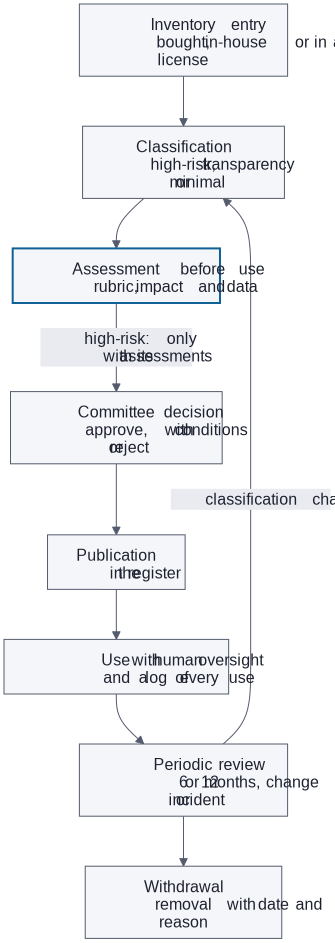
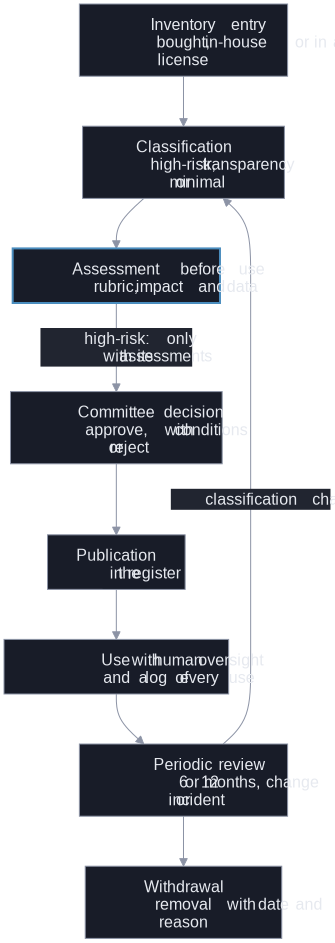
The cycle would show the path of each use, from entry to withdrawal; the committee and the owning units would run it.

<figure class="deliverable-diagram">
  <img class="dg-light" src="/cases/how-would-a-public-body-govern-its-use-of-ai/governance-cycle-en-light.svg" alt="the body's AI governance cycle" width="335" height="943" loading="lazy" decoding="async">
  <img class="dg-dark" src="/cases/how-would-a-public-body-govern-its-use-of-ai/governance-cycle-en-dark.svg" alt="the body's AI governance cycle" width="335" height="943" loading="lazy" decoding="async">
  <figcaption>
    <p class="cd-caption-title" id="deliverable-diagram">Illustrative example: the body's AI governance cycle</p>
    <ol><li>Inventory entry for every new use, whether bought, built in-house or included in a license</li><li>Classification: high-risk, transparency or minimal, and whether or not it produces administrative acts with no direct human intervention</li><li>Assessment before use: the rubric if it is bought, plus the fundamental rights impact assessment and the data protection impact assessment if it is high-risk; a high-risk use does not reach the decision without its assessments</li><li>Committee decision: approve, approve with conditions or reject</li><li>Publication in the algorithm register</li><li>Use with human oversight and a log of every use</li><li>A periodic review, every 6 months for high-risk uses and every 12 for the rest, and also after a material change to the system, the vendor or the use, or after an incident; if the classification changes, the use goes back to the classification step</li><li>Withdrawal: removal from the register with a date and a reason, keeping the historical entry</li></ol>
  </figcaption>
</figure>

### Risk register for the public use of AI

The committee would go over it at every review of the cycle. Where they apply, the identifiers follow the 2026 edition of OWASP: [dependence on the supply chain](https://github.com/GenAI-Security-Project/GenAI-LLM-Top10/blob/main/2026/final/LLM04_SupplyChain.md), [misinformation in the replies](https://github.com/GenAI-Security-Project/GenAI-LLM-Top10/blob/main/2026/final/LLM07_Misinformation.md) and [disclosure of sensitive information](https://github.com/GenAI-Security-Project/GenAI-LLM-Top10/blob/main/2026/final/LLM02_SensitiveInformationDisclosure.md).

<div class="case-table-wrap" role="region" aria-labelledby="deliverable-risks" tabindex="0">
  <table class="case-table">
    <caption id="deliverable-risks">Illustrative example: the body's risk register for the public use of AI</caption>
    <thead><tr><th scope="col">Risk</th><th scope="col">Level</th><th scope="col">Detection</th><th scope="col">Mitigation</th></tr></thead>
    <tbody>
      <tr><th scope="row">R1. Bias: the sample use #IA-02 systematically holds back one group of applicants, a fairness risk with no OWASP id</th><td>High</td><td>A quarterly sample of 100-200 case files checked by staff who cannot see the assigned order, with an alert if the share of files flagged as priority differs by more than 5 percentage points between groups</td><td>The automatic ordering is suspended and files go back to order of arrival during the review</td></tr>
      <tr><th scope="row">R2. Opacity: the body cannot explain to a person why their file ended up where it did, or answer an access request, with no OWASP id</th><td>High</td><td>A test access request about the use at every review of the cycle</td><td>The detailed register entry and the transparency documentation required in the rubric</td></tr>
      <tr><th scope="row">R3. Vendor dependence: the system cannot be audited or the contract exited, and the model changes without notice, <a href="https://github.com/GenAI-Security-Project/GenAI-LLM-Top10/blob/main/2026/final/LLM04_SupplyChain.md">LLM04:2026 Supply Chain</a></th><td>Medium</td><td>The auditability and exit criteria of the rubric, at every purchase and renewal</td><td>Audit access, advance notice of model changes and export in an open format</td></tr>
      <tr><th scope="row">R4. The information assistant gives a wrong requirement, deadline or document for a procedure, <a href="https://github.com/GenAI-Security-Project/GenAI-LLM-Top10/blob/main/2026/final/LLM07_Misinformation.md">LLM07:2026 Misinformation (OWASP)</a></th><td>Medium</td><td>A review of replies about procedures against the body's current information</td><td>Reply only from the published information on the procedure, and refer to citizen services when there is none</td></tr>
      <tr><th scope="row">R5. Personal data of members of the public in replies, logs or call summaries that should not contain it, <a href="https://github.com/GenAI-Security-Project/GenAI-LLM-Top10/blob/main/2026/final/LLM02_SensitiveInformationDisclosure.md">LLM02:2026 Sensitive Information Disclosure</a></th><td>High</td><td>A review of samples of logs and summaries at every review of the cycle</td><td>Personal data is minimized and logs are kept only for the period the body sets</td></tr>
    </tbody>
  </table>
</div>

### ADR: what the algorithm register publishes

The sample ADR would decide what the register publishes and in how much detail. Its design reference, not an obligation, is [the UK guidance on the algorithmic transparency recording standard](https://www.gov.uk/government/publications/guidance-for-organisations-using-the-algorithmic-transparency-recording-standard/algorithmic-transparency-recording-standard-guidance-for-public-sector-bodies), which separates a tier 1 in plain language for the general public from a tier 2 for specialist audiences, spread over eight sheets.

<figure class="deliverable">
<figcaption id="deliverable-adr">Illustrative example: sample ADR on the content of the algorithm register</figcaption>

```markdown
---
status: Proposed (illustrative scenario)
decision-makers: the body's AI governance committee
---
# Sample ADR: what the algorithm register publishes

## Context and Problem Statement
The public must be able to know which algorithms the body uses, and
anyone who wants to review them in depth must be able to do so, without
publishing anything that would let someone get around a control, or any
personal data.

## Decision Drivers
- Two audiences: the public and specialist audiences.
- Publication before the use begins.
- No omission without its reason.

## Considered Options
- A two-tier register: a short entry and a detailed entry.
- A list with the name and purpose of each use.
- Publishing everything, code and parameters included.

## Decision Outcome
Recommended option: the two-tier register.
Short entry, for every use: name, purpose in plain language, owning
unit, whether it decides or helps to decide, classification, how to
request human review, and contact.
Detailed entry, for high-risk uses and those that interact with the
public: data used, how it works at a high level, accuracy metrics and
metrics of differences between groups, a summary of the impact
assessments, vendor and contract, oversight and the last review.
In no entry: thresholds that would let someone get around a control,
personal data or security details; each omission, with its reason.

### Consequences
- Good: each audience finds the level of detail it needs.
- Good: the entry is published before the use and updated at every
  review of the cycle.
- Bad: the detailed entry needs information that some current
  contracts do not oblige the vendor to give; what is available is
  published and the gap is stated.

### Confirmation
The committee reviews the entries at every periodic review of the cycle.

## Pros and Cons of the Options
- List with name and purpose: simple, but it allows no in-depth review.
- Publishing everything: maximum openness, but it exposes thresholds,
  parameters and security details that would let someone get around a
  control.
```

</figure>

## Applicable regulatory framework

> General information, not legal advice. It is advisable to validate it with each organization's compliance team.

[See the full regulatory matrix](https://szemat.pro/en/regulatory-matrix/)

Instruments that could apply to this case, to validate with the compliance team

- [Bill 16.821-19 (Regula los sistemas de inteligencia artificial)](https://szemat.pro/en/regulatory-matrix/#cl-boletin-16821-19) · Jurisdiction: Chile · Industry: Cross-sector · Applicability: Preparation · Condition: Expected to apply: no official date. Not applicable on the access date: it is advisable to include it among the norms to validate with the compliance team. · Status: Bill
- [Exempt Resolution 372 of 2024 (Aprueba texto de las recomendaciones del Consejo para la Transparencia sobre transparencia algorítmica)](https://szemat.pro/en/regulatory-matrix/#cl-res-ex-372-2024) · Jurisdiction: Chile · Industry: Public sector · Applicability: Conditional · Condition: These are recommendations, not duties: if the public body is subject to the Transparency Law, they would guide the proactive publication of, and access to information on, its automated and semi-automated decision systems, such as the tool that sorts benefit applications. · Status: In force
- [Law 19.628 (Sobre protección de la vida privada)](https://szemat.pro/en/regulatory-matrix/#cl-ley-19628) · Jurisdiction: Chile · Industry: Cross-sector · Applicability: Direct · Condition: Pending part: Law 21.719 (Regula la protección y el tratamiento de los datos personales y crea la Agencia de Protección de Datos Personales) (2026-12-01) · Status: In force
- [Law 19.886 (Ley de bases sobre contratos administrativos de suministro y prestación de servicios)](https://szemat.pro/en/regulatory-matrix/#cl-ley-19886) · Jurisdiction: Chile · Industry: Cross-sector, Public sector · Applicability: Conditional · Condition: If the public body is within the scope of this instrument, buying or renewing an AI system, or a license that includes one, would follow the procedures of this instrument; the case's rubric would go into the tender documents and the award criteria the instrument allows, without replacing its rules. · Status: In force
- [Law 20.609 (Establece medidas contra la discriminación)](https://szemat.pro/en/regulatory-matrix/#cl-ley-20609) · Jurisdiction: Chile · Industry: Cross-sector · Applicability: Conditional · Condition: If the tool that sorts benefit applications treats people differently because of a protected characteristic or a proxy for one, this instrument would come into play. · Status: In force
- [Law 21.663 (Ley Marco de Ciberseguridad)](https://szemat.pro/en/regulatory-matrix/#cl-ley-21663) · Jurisdiction: Chile · Industry: Cross-sector · Applicability: Conditional · Condition: If this instrument includes the public body among the entities or operators it binds, a security incident in an AI system would fall under its management and reporting duties. · Status: In force
- [Law 21.719 (Regula la protección y el tratamiento de los datos personales y crea la Agencia de Protección de Datos Personales)](https://szemat.pro/en/regulatory-matrix/#cl-ley-21719) · Jurisdiction: Chile · Industry: Cross-sector · Applicability: Preparation · Condition: Expected to apply 2026-12-01. Not applicable on the access date: it is advisable to include it among the norms to validate with the compliance team. · Status: Adopted, not yet applicable
- [Bill 025 of 2026 (Chamber of Representatives) (Por medio de la cual se regula la inteligencia artificial en Colombia para garantizar su desarrollo ético y responsable y se dictan otras disposiciones)](https://szemat.pro/en/regulatory-matrix/#co-pl-025-2026) · Jurisdiction: Colombia · Industry: Cross-sector · Applicability: Preparation · Condition: Expected to apply: no official date. Not applicable on the access date: it is advisable to include it among the norms to validate with the compliance team. · Status: Bill
- [CONPES Document 4144 of 2025 (Política Nacional de Inteligencia Artificial)](https://szemat.pro/en/regulatory-matrix/#co-conpes-4144) · Jurisdiction: Colombia · Industry: Cross-sector, Public sector · Applicability: Conditional · Condition: It is a public policy document, not a law: if the public body takes part in any of its actions, its guidance would frame the case's governance cycle. · Status: In force
- [Decree 338 of 2022 (Por el cual se adiciona el Título 21 a la Parte 2 del Libro 2 del Decreto Único 1078 de 2015, Reglamentario del Sector de Tecnologías de la Información y las Comunicaciones, con el fin de establecer los lineamientos generales para fortalecer la gobernanza de la seguridad digital, se crea el Modelo y las instancias de Gobernanza de Seguridad Digital y se dictan otras disposiciones)](https://szemat.pro/en/regulatory-matrix/#co-decreto-338) · Jurisdiction: Colombia · Industry: Cross-sector · Applicability: Conditional · Condition: If the public body is a Public Administration entity, a digital security incident in an AI system would fall under the report to the competent authorities this decree calls for. · Status: In force
- [Law 80 of 1993 (Por la cual se expide el Estatuto General de Contratación de la Administración Pública)](https://szemat.pro/en/regulatory-matrix/#co-ley-80) · Jurisdiction: Colombia · Industry: Public sector · Applicability: Conditional · Condition: If the public body is within the scope of this instrument, buying or renewing an AI system, or a license that includes one, would follow the procedures of this instrument; the case's rubric would go into the tender documents and the award criteria the instrument allows, without replacing its rules. · Status: In force
- [SIC External Circular 002 of 2024 (Lineamientos sobre el Tratamiento de Datos personales en Sistemas de Inteligencia Artificial)](https://szemat.pro/en/regulatory-matrix/#co-sic-ce-002-2024) · Jurisdiction: Colombia · Industry: Cross-sector · Applicability: Direct · Status: In force
- [Statutory Law 1581 of 2012 (Por la cual se dictan disposiciones generales para la protección de datos personales)](https://szemat.pro/en/regulatory-matrix/#co-ley-1581) · Jurisdiction: Colombia · Industry: Cross-sector · Applicability: Direct · Status: In force
- [Law 29733 (Ley de Protección de Datos Personales)](https://szemat.pro/en/regulatory-matrix/#pe-ley-29733) · Jurisdiction: Peru · Industry: Cross-sector · Applicability: Direct · Status: In force
- [Law 32069 (Ley General de Contrataciones Públicas)](https://szemat.pro/en/regulatory-matrix/#pe-ley-32069) · Jurisdiction: Peru · Industry: Public sector · Applicability: Conditional · Condition: If the public body is within the scope of this instrument, buying or renewing an AI system, or a license that includes one, would follow the procedures of this instrument; the case's rubric would go into the tender documents and the award criteria the instrument allows, without replacing its rules. · Status: In force
- [Supreme Decree 016-2024-JUS (Reglamento de la Ley Nº 29733, Ley de Protección de Datos Personales)](https://szemat.pro/en/regulatory-matrix/#pe-ds-016-2024-jus) · Jurisdiction: Peru · Industry: Cross-sector · Applicability: Direct · Condition: Pending part: Data protection officer mandatory for medium companies (annual sales above 1700 and up to 2300 UIT) (2026-11-30); Data protection officer mandatory for small companies (annual sales above 150 and up to 1700 UIT) (2027-11-30); Data protection officer mandatory for microenterprises (annual sales up to 150 UIT) (2028-11-30) · Status: Partially in force
- [Supreme Decree 115-2025-PCM (Reglamento de la Ley Nº 31814, Ley que promueve el uso de la inteligencia artificial en favor del desarrollo económico y social del país)](https://szemat.pro/en/regulatory-matrix/#pe-ds-115-2025-pcm) · Jurisdiction: Peru · Industry: Cross-sector · Applicability: Conditional · Condition: If the public body's use of AI falls within the scope of this regulation, its duties would apply to it; the stages the row lists, from 2027-09-10, concern the private sector. Pending part: Private sector: AI uses in transport, commerce and labour, and small companies (2027-09-10); Private sector: AI uses in production, agriculture, energy and mining, and microenterprises (2028-09-10); Private sector: all other AI uses (2029-09-10) · Status: Partially in force
- [Supreme Decree 126-2025-PCM (Decreto Supremo que aprueba el Reglamento del Decreto de Urgencia N° 007-2020, Decreto de Urgencia que aprueba el Marco de Confianza Digital y dispone medidas para su fortalecimiento)](https://szemat.pro/en/regulatory-matrix/#pe-ds-126-2025-pcm) · Jurisdiction: Peru · Industry: Cross-sector · Applicability: Conditional · Condition: If the public body is within the scope of the Digital Trust Framework, a critical-level incident in an AI system would be notified to the National Digital Security Centre within the deadline of this regulation, and automated decisions based on algorithms would have the reporting channel it provides. · Status: In force
- [Decree 1023/2001 (Régimen de Contrataciones de la Administración Nacional)](https://szemat.pro/en/regulatory-matrix/#ar-decreto-1023-2001) · Jurisdiction: Argentina · Industry: Public sector · Applicability: Conditional · Condition: If the public body is a jurisdiction or entity of the National Administration (provinces and municipalities have their own regimes), buying or renewing an AI system, or a license that includes one, would follow the procedures of this instrument; the case's rubric would go into the tender documents and the award criteria the instrument allows, without replacing its rules. · Status: In force
- [Law 23.592 (Adóptanse medidas para quienes arbitrariamente impidan el pleno ejercicio de los derechos y garantías fundamentales reconocidos en la Constitución Nacional)](https://szemat.pro/en/regulatory-matrix/#ar-ley-23592) · Jurisdiction: Argentina · Industry: Cross-sector · Applicability: Conditional · Condition: If the tool that sorts benefit applications treats people differently because of a protected characteristic or a proxy for one, this instrument would come into play. · Status: In force
- [Law 25.326 (Ley de Protección de los Datos Personales)](https://szemat.pro/en/regulatory-matrix/#ar-ley-25326) · Jurisdiction: Argentina · Industry: Cross-sector · Applicability: Conditional · Condition: If the citizens' data processed by the uses in the inventory sit in databases this law covers, that processing would follow this instrument, and its art. 20 would come into play if an administrative act were based solely on the computerized processing of personal data; the case assumes none is. · Status: In force
- [SSTI Provision 2/2023 (Recomendaciones para una Inteligencia Artificial Fiable)](https://szemat.pro/en/regulatory-matrix/#ar-disp-ssti-2-2023) · Jurisdiction: Argentina · Industry: Cross-sector · Applicability: Conditional · Condition: These are non-binding recommendations: if the public body is part of the national public sector, they would guide the design and use of its AI systems. · Status: In force
- [Executive Decree 193 (Reglamento General de la Ley Orgánica del Sistema Nacional de Contratación Pública)](https://szemat.pro/en/regulatory-matrix/#ec-decreto-193-2025) · Jurisdiction: Ecuador · Industry: Public sector · Applicability: Conditional · Condition: If the public body is within the scope of this instrument, buying or renewing an AI system, or a license that includes one, would follow the procedures of this instrument; the case's rubric would go into the tender documents and the award criteria the instrument allows, without replacing its rules. · Status: In force
- [Ley Orgánica de Protección de Datos Personales](https://szemat.pro/en/regulatory-matrix/#ec-lopdp) · Jurisdiction: Ecuador · Industry: Cross-sector · Applicability: Direct · Condition: Pending part: Filing 483742 (Proyecto de Ley Orgánica Reformatoria a la Ley Orgánica de Protección de Datos Personales) (no official date) · Status: In force
- [Ley Orgánica para el Fortalecimiento de la Ciberseguridad](https://szemat.pro/en/regulatory-matrix/#ec-ley-ciberseguridad) · Jurisdiction: Ecuador · Industry: Cross-sector · Applicability: Conditional · Condition: If a cybersecurity incident affects one of the public body's AI systems, it would fall under the notice to the governing body this law asks of public entities, within the deadline it sets. · Status: In force
- [Proyecto de Ley Orgánica para el Desarrollo, Uso Ético y Gobernanza de la Inteligencia Artificial en el Ecuador](https://szemat.pro/en/regulatory-matrix/#ec-proyecto-ley-ia) · Jurisdiction: Ecuador · Industry: Cross-sector · Applicability: Preparation · Condition: Expected to apply: no official date. Not applicable on the access date: it is advisable to include it among the norms to validate with the compliance team. · Status: Bill
- [Resolution SPDP-SPD-2025-0003-R (Guía de Gestión de Riesgos y Evaluación de Impacto del Tratamiento de Datos Personales)](https://szemat.pro/en/regulatory-matrix/#ec-spdp-2025-0003-r) · Jurisdiction: Ecuador · Industry: Cross-sector · Applicability: Conditional · Condition: If processing sensitive data with a new technology is considered high risk, the impact assessment this guide describes would be needed. · Status: In force
- [Resolution SPDP-SPD-2025-0006-R (Reglamento que establece la obligación de incorporar cláusulas de protección de datos personales en los contratos celebrados dentro del territorio de la República del Ecuador)](https://szemat.pro/en/regulatory-matrix/#ec-spdp-2025-0006-r) · Jurisdiction: Ecuador · Industry: Cross-sector · Applicability: Conditional · Condition: If an external model or cloud provider processes personal data on behalf of the public body, the contract would need the data protection clauses this instrument calls for. · Status: In force
- [Resolution SPDP-SPD-2026-0009-R (Norma General para la Garantía del Derecho de Protección de Datos Personales en el Uso de Sistemas de Inteligencia Artificial)](https://szemat.pro/en/regulatory-matrix/#ec-spdp-2026-0009-r) · Jurisdiction: Ecuador · Industry: Cross-sector · Applicability: Direct · Status: In force
- [Ley de Adquisiciones, Arrendamientos y Servicios del Sector Público](https://szemat.pro/en/regulatory-matrix/#mx-laassp-2025) · Jurisdiction: Mexico · Industry: Public sector · Applicability: Conditional · Condition: If the public body is an agency or entity of the Federal Public Administration, or a state or municipal body buying wholly or partly with federal funds, buying or renewing an AI system, or a license that includes one, would follow the procedures of this instrument; the case's rubric would go into the tender documents and the award criteria the instrument allows, without replacing its rules. Pending part: Computed outer deadline (30 months from entry into force) for the Plataforma Digital de Contrataciones Públicas to operate in full (2027-10-17) · Status: Partially in force
- [Ley Federal para Prevenir y Eliminar la Discriminación](https://szemat.pro/en/regulatory-matrix/#mx-lfped) · Jurisdiction: Mexico · Industry: Cross-sector · Applicability: Conditional · Condition: If the tool that sorts benefit applications treats people differently because of a protected characteristic or a proxy for one, this instrument would come into play. · Status: In force
- [Executive Decree 37554-JP (Reglamento a la Ley de Protección de la Persona frente al Tratamiento de sus Datos Personales)](https://szemat.pro/en/regulatory-matrix/#cr-de-37554-jp) · Jurisdiction: Costa Rica · Industry: Cross-sector · Applicability: Direct · Status: In force
- [Executive Decree 45061-MICITT (Reglamento para la gobernanza en ciberseguridad y la resiliencia cibernética de las Instituciones Gubernamentales)](https://szemat.pro/en/regulatory-matrix/#cr-de-45061-micitt) · Jurisdiction: Costa Rica · Industry: Cross-sector · Applicability: Conditional · Condition: If the public body belongs to the Central Administration, an incident in an AI system would fall under the report to CSIRT-CR that its art. 14 asks of the heads of institutions; this decree only urges the decentralized administration. · Status: In force
- [Law 8968 (Ley de Protección de la Persona frente al tratamiento de sus datos personales)](https://szemat.pro/en/regulatory-matrix/#cr-ley-8968) · Jurisdiction: Costa Rica · Industry: Cross-sector · Applicability: Direct · Status: In force
- [Law 9986 (Ley General de Contratación Pública)](https://szemat.pro/en/regulatory-matrix/#cr-ley-9986) · Jurisdiction: Costa Rica · Industry: Public sector · Applicability: Conditional · Condition: If it is paid for wholly or partly with public funds, buying or renewing an AI system, or a license that includes one, would follow the procedures of this instrument; the case's rubric would go into the tender documents and the award criteria the instrument allows, without replacing its rules. · Status: In force
- [Bill PL 2338/2023 (Dispõe sobre o desenvolvimento, o fomento e o uso ético e responsável da inteligência artificial com base na centralidade da pessoa humana)](https://szemat.pro/en/regulatory-matrix/#br-pl-2338-2023) · Jurisdiction: Brazil · Industry: Cross-sector · Applicability: Preparation · Condition: Expected to apply: no official date. Not applicable on the access date: it is advisable to include it among the norms to validate with the compliance team. · Status: Bill
- [Law 13.709/2018 (Lei Geral de Proteção de Dados Pessoais (LGPD))](https://szemat.pro/en/regulatory-matrix/#br-lei-13709) · Jurisdiction: Brazil · Industry: Cross-sector · Applicability: Direct · Status: In force
- [Law 14.133/2021 (Lei de Licitações e Contratos Administrativos)](https://szemat.pro/en/regulatory-matrix/#br-lei-14133) · Jurisdiction: Brazil · Industry: Public sector · Applicability: Conditional · Condition: If the public body is within the scope of this instrument, buying or renewing an AI system, or a license that includes one, would follow the procedures of this instrument; the case's rubric would go into the tender documents and the award criteria the instrument allows, without replacing its rules. · Status: In force
- [Decree 150/012 (TOCAF 2012) (Aprobación del Texto Ordenado de la Contabilidad y Administración Financiera del Estado (TOCAF). Sustitución del Texto Ordenado de Contabilidad y Administración Financiera y Normas Concordantes y Complementarias (TOCAF 1996))](https://szemat.pro/en/regulatory-matrix/#uy-tocaf-2012) · Jurisdiction: Uruguay · Industry: Public sector · Applicability: Conditional · Condition: If the public body is one of those its art. 2 lists, buying or renewing an AI system, or a license that includes one, would follow the procedures of this instrument; the case's rubric would go into the tender documents and the award criteria the instrument allows, without replacing its rules. Pending part: Law 20.531 (arts. 14 to 16, 18 and 19) (Aprobación de la Rendición de Cuentas y Balance de Ejecución Presupuestal. Ejercicio 2025) (2027-01-01) · Status: In force
- [Law 18.331 (Ley de Protección de Datos Personales)](https://szemat.pro/en/regulatory-matrix/#uy-ley-18331) · Jurisdiction: Uruguay · Industry: Cross-sector · Applicability: Direct · Status: In force
- [Law 20.212 (arts. 78 to 84) (Aprobación de Rendición de Cuentas y Balance de Ejecución Presupuestal. Ejercicio 2022)](https://szemat.pro/en/regulatory-matrix/#uy-ley-20212-arts-78-84) · Jurisdiction: Uruguay · Industry: Cross-sector · Applicability: Conditional · Condition: If the public body is a public entity within the scope of these articles, an incident in an AI system would have to be reported to AGESIC within the deadline art. 80 sets. · Status: In force
- [48 CFR Chapter 1 (Federal Acquisition Regulation)](https://szemat.pro/en/regulatory-matrix/#us-48-cfr-chapter-1) · Jurisdiction: United States (federal and key states) · Industry: Public sector · Applicability: Conditional · Condition: If the public body is a federal executive agency, buying or renewing an AI system, or a license that includes one, would follow the procedures of this instrument; the case's rubric would go into the tender documents and the award criteria the instrument allows, without replacing its rules. · Status: In force
- [Public Law 117-263, division G, title LXXII, subtitle B (Advancing American AI Act)](https://szemat.pro/en/regulatory-matrix/#us-advancing-american-ai-act) · Jurisdiction: United States (federal and key states) · Industry: Public sector · Applicability: Conditional · Condition: If the public body is a federal agency outside the intelligence community, it would have to maintain and publish, to the extent practicable, the inventory of its AI use cases that section 7225 calls for; the case's inventory could serve as its basis. · Status: In force
- [Directive (EU) 2022/2555 (NIS 2 Directive)](https://szemat.pro/en/regulatory-matrix/#eu-directiva-2022-2555) · Jurisdiction: European Union · Industry: Cross-sector · Applicability: Conditional · Condition: If this instrument includes the public body among the entities or operators it binds, a security incident in an AI system would fall under its management and reporting duties. Pending part: COM(2026) 13 (as regards simplification measures and alignment with the proposal for the Cybersecurity Act 2) (no official date); COM(2025) 837 (Digital Omnibus) (no official date) · Status: In force
- [Directive 2000/43/EC (implementing the principle of equal treatment between persons irrespective of racial or ethnic origin)](https://szemat.pro/en/regulatory-matrix/#eu-directiva-2000-43) · Jurisdiction: European Union · Industry: Cross-sector · Applicability: Conditional · Condition: If the tool that sorts benefit applications treats people differently because of a protected characteristic or a proxy for one, this instrument would come into play. · Status: In force
- [Directive 2014/24/EU (on public procurement)](https://szemat.pro/en/regulatory-matrix/#eu-directiva-2014-24) · Jurisdiction: European Union · Industry: Public sector · Applicability: Conditional · Condition: If the estimated value of buying or renewing an AI system reaches the thresholds of this Directive, the procedure would follow the national law that transposes it, and the case's rubric would go into the tender documents and the award criteria that law allows, without replacing its rules. Pending part: COM(2026) 590 (Public Procurement Act) (no official date) · Status: In force
- [Regulation (EU) 2016/679 (General Data Protection Regulation)](https://szemat.pro/en/regulatory-matrix/#eu-reglamento-2016-679) · Jurisdiction: European Union · Industry: Cross-sector · Applicability: Direct · Condition: Pending part: COM(2025) 837 (Digital Omnibus) (no official date); COM(2025) 501 (extension of certain mitigating measures available for small and medium sized enterprises to small mid-cap enterprises and further simplification measures) (no official date) · Status: In force
- [Regulation (EU) 2024/1689 (Artificial Intelligence Act)](https://szemat.pro/en/regulatory-matrix/#eu-reglamento-2024-1689) · Jurisdiction: European Union · Industry: Cross-sector · Applicability: Conditional · Condition: If a use fell under Annex III, point 5(a), for example the tool that sorts benefit applications if it takes part in evaluating eligibility for a benefit, granting, reducing or revoking it, or reclaiming it, it could be high-risk, unless the exception in Article 6(3) applies, which it cannot when the system profiles natural persons; the public body, as a deployer that is a public authority, would carry out the fundamental rights impact assessment of Article 27, as amended by Regulation (EU) 2026/1744, before using it, and would register its use in the EU database (Articles 26(8) and 49(3)); Chapter III, Sections 1 to 3, applies to Annex III high-risk systems from 2027-12-02, according to the row. If a system interacts directly with people, such as the information assistant, Article 50(1) requires the provider to ensure it is designed and developed so that people are informed they are interacting with an AI system, and the public body would require it in the purchase. Pending part: The Article 5 prohibitions dated by Regulation (EU) 2026/1744 apply, and the Article 50(2) deadline falls due for generative systems placed on the market before 2026-08-02 (2026-12-02); Article 111(3) deadline for general-purpose AI models placed on the market before 2025-08-02 (2027-08-02); Chapter III, Sections 1 to 3, for high-risk systems under Article 6(2) and Annex III (2027-12-02); Chapter III, Sections 1 to 3, for high-risk systems under Article 6(1) and Annex I (2028-08-02); COM(2025) 1023 (simplifying and reducing the burden of the rules on medical devices and in vitro diagnostic medical devices) (no official date) · Status: Partially in force
- [Law 15/2022 (Integral para la igualdad de trato y la no discriminación)](https://szemat.pro/en/regulatory-matrix/#es-ley-15-2022) · Jurisdiction: Spain · Industry: Cross-sector · Applicability: Conditional · Condition: If the tool that sorts benefit applications treats people differently because of a protected characteristic or a proxy for one, this instrument would come into play. · Status: In force
- [Law 40/2015 (De Régimen Jurídico del Sector Público)](https://szemat.pro/en/regulatory-matrix/#es-ley-40-2015) · Jurisdiction: Spain · Industry: Public sector · Applicability: Conditional · Condition: If a use came to produce acts without direct human involvement, it would be automated administrative action under art. 41, and before using it the body competent for the specifications, the supervision and, where appropriate, the audit of the system and its source code would have to be set, together with the body responsible for appeals; the case assumes no use does so. · Status: In force
- [Law 9/2017 (De Contratos del Sector Público, por la que se transponen al ordenamiento jurídico español las Directivas del Parlamento Europeo y del Consejo 2014/23/UE y 2014/24/UE, de 26 de febrero de 2014)](https://szemat.pro/en/regulatory-matrix/#es-ley-9-2017) · Jurisdiction: Spain · Industry: Public sector · Applicability: Conditional · Condition: If the public body is within the scope of this instrument, buying or renewing an AI system, or a license that includes one, would follow the procedures of this instrument; the case's rubric would go into the tender documents and the award criteria the instrument allows, without replacing its rules. · Status: In force
- [Organic Law 3/2018 (Protección de Datos Personales y garantía de los derechos digitales)](https://szemat.pro/en/regulatory-matrix/#es-lo-3-2018) · Jurisdiction: Spain · Industry: Cross-sector · Applicability: Direct · Status: In force
- [Royal Decree 203/2021 (Por el que se aprueba el Reglamento de actuación y funcionamiento del sector público por medios electrónicos)](https://szemat.pro/en/regulatory-matrix/#es-rd-203-2021) · Jurisdiction: Spain · Industry: Public sector · Applicability: Conditional · Condition: If the public body belongs to the State public sector and a use came to produce automated actions, each would need the authorization by a resolution published on the electronic office that art. 13 calls for; the case assumes no use does so. · Status: In force
- [Royal Decree 311/2022 (Por el que se regula el Esquema Nacional de Seguridad)](https://szemat.pro/en/regulatory-matrix/#es-rd-311-2022) · Jurisdiction: Spain · Industry: Cross-sector · Applicability: Direct · Status: In force
- [Algorithmic Transparency Recording Standard (ATRS) Mandatory Scope and Exemptions Policy](https://szemat.pro/en/regulatory-matrix/#uk-atrs) · Jurisdiction: United Kingdom · Industry: Public sector · Applicability: Conditional · Condition: It is a government policy, not a law: if the public body is a government department, or an arm's-length body that provides public or frontline services, or routinely interacts with the general public, it would have to publish an ATRS record for the algorithmic tools in its mandatory scope that are not exempt; for the rest of the public sector it is a recommendation. The case's ADR uses its guidance as a design reference. · Status: In force
- [Data (Use and Access) Act 2025](https://szemat.pro/en/regulatory-matrix/#uk-duaa-2025) · Jurisdiction: United Kingdom · Industry: Cross-sector · Applicability: Conditional · Condition: If a use came to take significant decisions based solely on automated processing, the rules on automated decision-making this Act brings into the UK GDPR would come into play; the case assumes no decision goes out without human review. · Status: In force
- [Data Protection Act 2018](https://szemat.pro/en/regulatory-matrix/#uk-dpa-2018) · Jurisdiction: United Kingdom · Industry: Cross-sector · Applicability: Direct · Status: In force
- [Equality Act 2010](https://szemat.pro/en/regulatory-matrix/#uk-equality-act-2010) · Jurisdiction: United Kingdom · Industry: Cross-sector · Applicability: Conditional · Condition: If the tool that sorts benefit applications treats people differently because of a protected characteristic or a proxy for one, this instrument would come into play. · Status: In force
- [Procurement Act 2023](https://szemat.pro/en/regulatory-matrix/#uk-procurement-act-2023) · Jurisdiction: United Kingdom · Industry: Public sector · Applicability: Conditional · Condition: If the public body is a contracting authority under this Act, buying or renewing an AI system, or a license that includes one, would follow the procedures of this instrument; the case's rubric would go into the tender documents and the award criteria the instrument allows, without replacing its rules. · Status: In force
- [Regulation (EU) 2016/679 (United Kingdom General Data Protection Regulation)](https://szemat.pro/en/regulatory-matrix/#uk-gdpr) · Jurisdiction: United Kingdom · Industry: Cross-sector · Applicability: Direct · Status: In force
- [ISO/IEC 42001:2023 (Information technology - Artificial intelligence - Management system)](https://szemat.pro/en/regulatory-matrix/#int-iso-iec-42001) · Jurisdiction: International · Industry: Cross-sector · Applicability: Conditional · Condition: Voluntary framework, not a law: it would apply only if the organization chooses to adopt it. The public body could use it as an AI management system into which the committee, the inventory and the cycle reviews would fit. · Status: Voluntary framework
- [NIST AI 100-1 (Artificial Intelligence Risk Management Framework (AI RMF 1.0))](https://szemat.pro/en/regulatory-matrix/#int-nist-ai-rmf) · Jurisdiction: International · Industry: Cross-sector · Applicability: Conditional · Condition: Voluntary framework, not a law: it would apply only if the organization chooses to adopt it. The case could use it to organize the govern, map, measure and manage functions of the cycle. · Status: Voluntary framework
- [OWASP Top 10 for LLM Applications 2026](https://szemat.pro/en/regulatory-matrix/#int-owasp-llm-top10) · Jurisdiction: International · Industry: Cross-sector · Applicability: Conditional · Condition: Voluntary framework, not a law: it would apply only if the organization chooses to adopt it. The case uses it to name the risks in the risk register for the public use of AI. · Status: Voluntary framework

## Claims register

- claim-1, Illustrative assumption: The figures of this scenario (staff, population, case files, units, uses, IT team and launch) are delegated illustrative assumptions given as ranges, not data from an executed engagement. (Basis: [Assumptions in this scenario](https://szemat.pro/en/cases/how-would-a-public-body-govern-its-use-of-ai/#assumptions-in-this-scenario); As of 2026-11-17)
- claim-2, Regulatory: With Regulation (EU) 2026/1744, the Annex III high-risk obligations of the EU Artificial Intelligence Act would apply from 2 December 2027. (Basis: [Regulation (EU) 2024/1689 (Artificial Intelligence Act)](https://szemat.pro/en/regulatory-matrix/#eu-reglamento-2024-1689); As of 2026-11-13)

## Frequently asked questions

### Why start with an inventory if the body already knows what it bought?

Because part of the body's AI was never bought as AI: it arrives inside office software licenses, with the portal contract or in an update. An inventory built only by asking the units would miss it, which is why I would also review every current contract and license.

### What would happen to AI that comes inside a software license?

It would be treated like any other use: entered in the inventory and classified, with an owning unit and a review date. At the next renewal it would go through the purchasing rubric, and in the meantime its register entry would state what information is missing and why.

### When could a public use of AI be high-risk?

Under the EU AI Act, for example, when a public authority uses it to evaluate eligibility for essential public assistance benefits and services, or to grant, reduce, revoke or reclaim them. The legal team in each jurisdiction would always confirm how every use is classified.

### Who would review a decision, and how would the person affected ask for it?

In high-risk uses, no decision affecting a person would go out until someone in the body has reviewed and signed it. The short register entry would explain how to request that human review and whom to contact.

### What would the register publish, and what not?

A short entry for every use and a detailed entry for high-risk uses and for those that interact with the public. It would not publish thresholds that would let someone get around a control, personal data or security details, and each omission would be stated in the entry with its reason.

### How would dependence on a single vendor be avoided?

Through the exit and portability criterion of the rubric: export of data, configurations and logs in an open format, a transition plan and advance notice of model changes. An offer with no way out would be ruled out even if its total were high.

### What would change in a jurisdiction with no mandatory algorithm register?

The cycle would stay the same. The register would become the body's own choice rather than an obligation, and the applicable framework table would show in which jurisdictions public registers or inventories of algorithms exist, and with what scope.
